

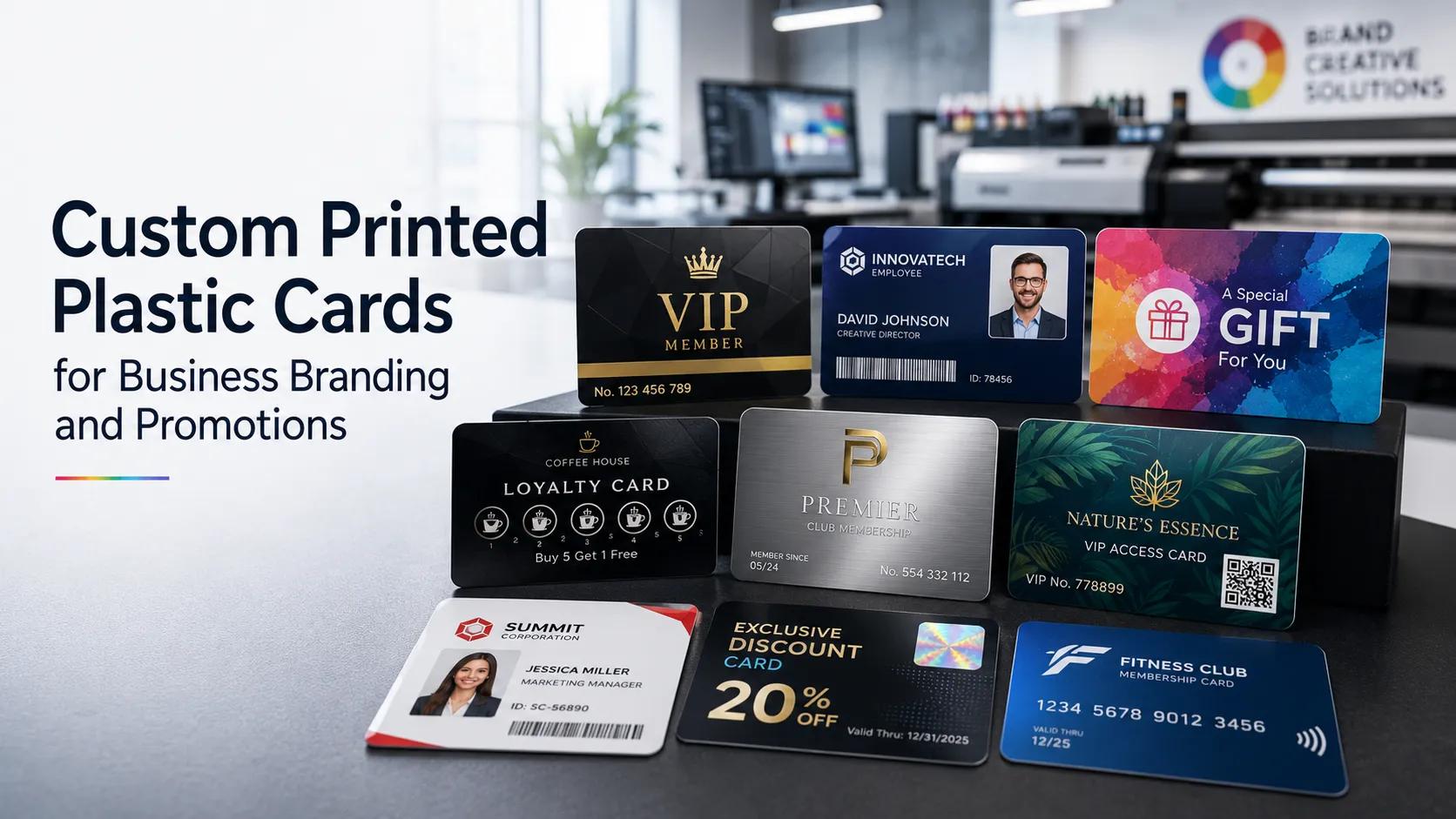
How Businesses Use Custom Printed Plastic Cards
Businesses across retail, hospitality, healthcare, and corporate sectors use custom-printed plastic cards as practical tools for branding, customer engagement, and internal operations. These cards carry company logos, contact details, encoded data, and visual design elements that reinforce brand identity every time they are handled.
Unlike paper alternatives, plastic cards are built to last through daily use. They fit standard wallets and cardholders, making them convenient for customers and employees alike. When produced with accurate color, clear typography, and quality materials, they communicate a level of professionalism that disposable or paper-based options cannot match.
The range of applications is broad. A single card format can serve as a loyalty card, a gift card, a membership credential, an access badge, or a promotional item, depending on what a business encodes and prints on it.
Materials and Construction Standards
Most custom-printed plastic cards are made from PVC or composite PVC materials. Card dimensions follow the CR80 standard, which measures 3.375 by 2.125 inches with a thickness of 30 mil. This size is identical to a standard credit card, so the cards work with existing card readers, badge holders, lanyards, and retail display fixtures without adjustment.
Surface Finish Options
Card surfaces are available in glossy or matte finishes. Glossy cards produce vivid color output and sharp photographic reproduction. Matte finishes reduce glare and are preferred in settings where cards are frequently handled under direct lighting, such as point-of-sale counters or outdoor events.
Some producers offer spot UV coating, which applies a high-gloss layer to selected areas of the card while leaving the rest matte. This technique draws attention to logos, icons, or text fields without changing the overall card format.
Card Thickness Variations
While 30 mil is the most common card thickness, thinner options at 10 mil and 20 mil are used for applications where flexibility or lower weight is preferred. Heavier cards at 40 to 50 mil are sometimes used for premium gift cards or high-end loyalty programs where the physical weight of the card signals quality to the recipient.
Design Features for Brand Consistency
The visual design of a plastic card is the most direct way a business communicates its brand through that format. Custom plastic cards can carry full color printing on one or both sides, allowing businesses to use the front for customer-facing branding and the back for legal text, website addresses, or encoded data.
Full-Color Printing Technology
Commercial card printing uses dye sublimation or offset printing, depending on order volume and detail requirements. Dye sublimation transfers color directly into the card surface, producing smooth gradients, accurate skin tones in photographs, and sharp, fine text. Offset printing is used for large-volume orders and delivers consistent color reproduction across thousands of cards.
Resolution typically runs between 300 and 600 dots per inch, which is sufficient for detailed logos, small text, and portrait photographs.
Variable Data Printing
Variable data printing allows a single card design to produce individually unique cards. Names, membership numbers, photographs, barcodes, and expiration dates can all change from card to card while the overall design stays constant. This approach is common for custom plastic membership cards, employee ID programs, and personalized gift cards.
Businesses that issue cards to individual customers or staff benefit from variable data printing because it removes the need for manual handwriting or label application. Each card arrives finished and ready to issue.
Color-Coded Design Systems
Organizations with multiple membership tiers, departments, or product categories often use color coding to distinguish card types at a glance. A retail loyalty program might issue silver, gold, and platinum tiers in distinct colors. A corporation might assign department-specific border colors to employee badges. Color coding reduces confusion at the point of use and reinforces the visual system that supports a brand.
Encoded Features That Add Functionality
Custom plastic cards become more functional when they carry encoded data in addition to a printed design. Encoding options expand what a card can do beyond visual identification.
Magnetic Stripes
Magnetic stripes store data in three tracks and are commonly used for loyalty programs, gift card balances, timekeeping systems, and building access. Point-of-sale systems in retail and hospitality environments are typically equipped to read magnetic stripe cards, making this one of the most widely compatible encoding formats.
Barcodes and QR Codes
Barcodes and QR codes can be printed directly onto the card surface and scanned with standard handheld or fixed readers. These formats are used for customer loyalty programs, event ticketing, inventory management, and visitor check-in systems.
Smart Chips and RFID
Smart chips and RFID technology allow cards to communicate with readers without physical contact. These formats support access control, transit systems, and secure data storage. Organizations that require layered authentication or encrypted data storage often choose chip-based cards over magnetic stripe alternatives.
Signature Panels
Signature panels are a simple addition that allows cardholders to sign the back of the card. These are standard on loyalty and membership cards where ownership verification at the point of use is required.
Custom Plastic Membership Cards and Loyalty Programs
Custom plastic membership cards are among the most common applications of card printing for businesses. Retailers, fitness centers, restaurants, professional associations, and subscription services all use membership cards to formalize the relationship between a business and its customers.
How Membership Cards Support Customer Retention
A physical membership card gives customers a tangible reminder of their relationship with a business. When a card is well-designed and durable, customers are more likely to keep it in their wallet and present it consistently at the point of purchase. This regularity creates data that businesses can use to understand purchasing patterns and tailor offers accordingly.
Membership cards also serve as a form of passive brand exposure. Every time a cardholder opens their wallet, the card is visible alongside cards from banks, transit authorities, and other businesses they interact with regularly.
Tiered Membership Structures
Many loyalty programs use tiered structures where customers advance through levels based on spending or engagement. Each tier may carry a distinct card design, color, or material finish to signal the cardholder's status. Custom plastic cards make this differentiation straightforward because each tier can be printed with its own design template while sharing the same physical card format.
Promotional Applications for Custom Plastic Cards
Beyond membership programs, businesses use custom plastic cards for short-term promotional purposes. Gift cards, event passes, referral cards, and promotional game pieces are all produced in the same card format.
Gift Cards
Gift cards are a significant revenue category for retail and hospitality businesses. A well-produced gift card functions as a prepaid payment instrument and a marketing tool simultaneously. Recipients who are not existing customers become familiar with a brand when they receive a card as a gift.
Promotional Game Cards
Some businesses use scratch-off or pull-tab card formats for in-store promotions. These cards are produced with an opaque coating over a printed area that reveals a message or code when removed. Custom plastic cards with scratch-off panels are more durable than paper scratch cards and carry better print quality for brand elements.
Event Access Cards
Conferences, trade shows, concerts, and corporate events issue access cards to registered attendees. Plastic event cards are more durable than paper wristbands or printed tickets and can carry encoded data for fast entry scanning. These cards also serve as keepsakes that attendees may retain after the event, extending the brand impression beyond the event date.
Selecting a Production Partner
Organizations evaluating providers for custom printed plastic cards should consider several practical criteria before placing an order.
Print quality and consistency should be verifiable through samples. Color accuracy, resolution, and finish quality should match between the sample and the final order.
Encoding capability matters for organizations that need magnetic stripes, chips, or barcodes. Not all card printers offer all encoding formats, so it is worth confirming compatibility before ordering.
Turnaround time affects project planning. Standard production timelines vary between providers, and some offer expedited options for time-sensitive orders.
Minimum order quantities differ between suppliers. Some cater to large enterprise orders while others serve small businesses that need smaller runs.
Data handling practices are relevant when submitting personal employee or customer information for variable data printing. Providers should follow clear data security protocols.
Perfect Plastic Cards handles production of custom plastic cards for businesses across multiple industries, covering full-color printing, variable data, and card encoding through an online ordering process.
Industry Applications at a Glance
Custom plastic cards are used across a wide range of sectors:
Retail: Loyalty cards, gift cards, and promotional scratch cards issued at the point of sale.
Healthcare: Patient ID cards, insurance cards, and staff credentials with photo and encoded access data.
Hospitality: Hotel key cards, restaurant loyalty cards, and club membership credentials.
Education: Student ID cards, library cards, and meal plan cards are issued each academic term.
Corporate: Employee ID badges, visitor passes, and access control cards for secure facilities.
Fitness and Wellness: Gym membership cards, class pass cards, and personal trainer credentials.
Each sector applies the same physical card format to different functions, which reflects how versatile the custom plastic card format is across business types.
Conclusion
Custom printed plastic cards serve a practical role in how businesses manage branding, customer relationships, and access control. The combination of durable materials, full color printing, and encoding options makes them suitable for a wide range of applications from loyalty programs and gift cards to employee credentials and event passes. As the demand for professional card production continues across industries, businesses that invest in well-designed custom plastic cards gain a consistent and recognizable tool for customer engagement and operational efficiency.