

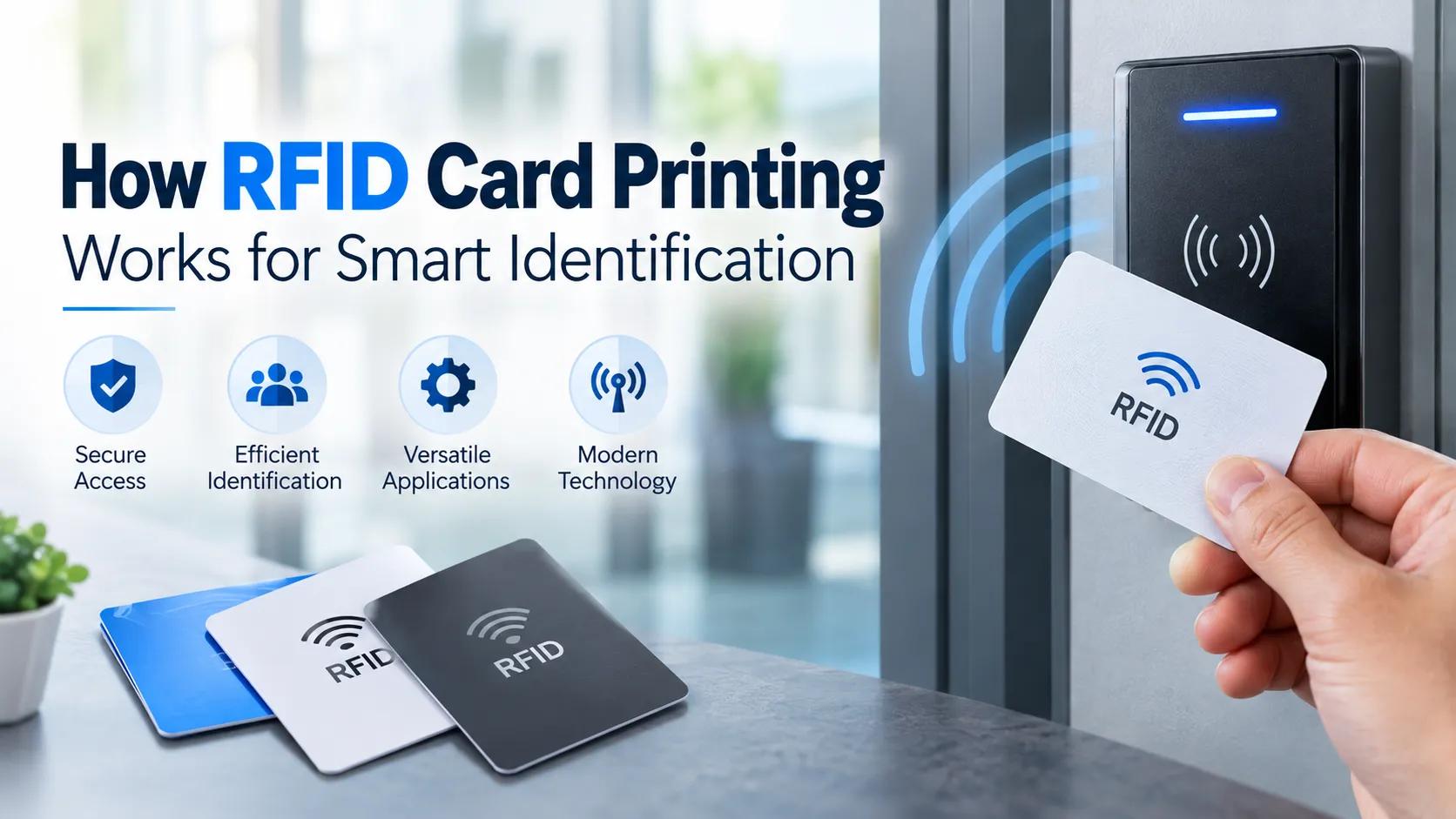
Radio frequency identification, known as RFID, allows a reader to collect data from a card without physical contact. When a card is held near a reader, the reader's radio field powers a small chip, and the chip sends back a stored code. Building access systems, payment terminals, attendance records, and asset tracking programs all rely on this exchange. RFID card printing is the manufacturing process that produces these cards. It combines visible printing on the card surface with electronic data preparation inside the card body.
What RFID Cards Are
RFID cards are plastic cards that contain a microchip and an antenna. Most are passive, which means they have no battery. The reader emits a radio field, the antenna collects energy from that field, and the chip uses the energy to respond. This design keeps the cards thin, light, and durable.
Cards operate on different frequency bands, and each band suits different uses:
Low frequency (125 kHz) has a short read range and appears in many older access control systems.
High frequency (13.56 MHz) also reads at close range and supports stronger security. ISO 14443, MIFARE, and NFC operate in this band.
Ultra-high frequency (860 to 960 MHz) reads at longer distances and is more common in logistics and vehicle access than in ID cards.
Main Parts of an RFID Card
The Chip and Antenna
The chip stores a unique identifier and, on some models, added data such as an employee number or access permissions. Memory size depends on the chip type. The antenna is a coil of thin copper or aluminum wire, or etched metal, connected to the chip. Together, the chip and antenna form the inlay, a thin layer that sits inside the finished card.
Card Layers and Materials
Manufacturers place the inlay between layers of PVC, the plastic used for most ID cards. Some cards use PET or polycarbonate when a longer service life is needed. Heat and pressure fuse the layers into one solid card. The standard size is CR80, which measures 3.375 by 2.125 inches, the same as a credit card.
The RFID Card Printing Process
Design and Data Planning
The process begins with artwork and data. The design sets the layout, colors, logos, text fields, and photo area. The data plan defines what is stored on the chip, such as a serial number, and what appears on the surface. The printed number and the encoded number often need to match, since a mismatch can cause errors in the system that reads the card.
Inlay Lamination and Card Body Production
In large production runs, printed PVC sheets are stacked with a sheet of inlays in the middle, laminated, and cut into individual cards. The cutting must be precise so the chip and antenna stay inside the card edges. For smaller runs, an organization may buy blank cards with inlays already inside and print on them directly.
Surface Printing Methods
Several methods place the visible design on the card:
Offset printing applies fixed artwork, such as logos and backgrounds, across large runs.
Digital printing suits shorter runs and allows different text or images on each card.
Dye sublimation and retransfer printers, common in office settings, print photos and personal details on demand.
Laser engraving marks text into polycarbonate cards in a way that is hard to alter.
Chip Encoding and Data Writing
An encoder writes data to the chip after printing or during printing in systems that combine both steps. The data may include a unique ID, access levels, or application records. Some chips are locked after writing so the data cannot change, while others stay rewritable. Advanced chips use secret keys so that only authorized readers can read or edit the data. Some desktop card printers include an encoder module, which allows printing and encoding in one pass.
Testing and Quality Checks
Finished cards are read on test equipment to confirm that the chip responds, the code matches the record, and the read range is normal. Inspectors also review print alignment, color accuracy, and edge quality. Cards that fail a check are removed from the batch.
Printing Options for RFID Cards
Card programs often add features to fit their needs. Custom RFID card printing may include a photo, a barcode or QR code, a magnetic stripe, a signature panel, a hologram, or sequential numbering. A barcode gives a backup reading method if the chip fails. Cards can be printed on one side or both, and finishes range from glossy to matte. Variable data printing lets each card carry a different name, title, or number while sharing the same base design.
Uses in Smart Identification
Smart identification uses cards that carry digital data linked to a person or an item. Common examples include:
Employee badges for door access and time tracking.
Student cards for campus entry, library loans, and meal plans
Hospital badges that limit entry to restricted areas
Hotel key cards and gym membership cards
Transit passes and event tickets
In each case, the system compares the code with a database and grants or denies the request within a fraction of a second.
Security Considerations
RFID cards differ in how well they protect data. Basic low-frequency cards send a fixed code that common equipment can copy. Higher frequency cards can use encryption and mutual authentication, in which the card and the reader each verify the other before exchanging data.
Organizations may also use card sleeves to block unwanted reads and keep records of issued cards so lost cards can be deactivated. Printed features such as holograms, microtext, and photos let staff check a card by eye.
Selecting a Provider for RFID Cards
An RFID card printing service handles design, printing, and chip encoding for organizations that do not produce cards in-house. Buyers usually confirm several points before ordering:
Frequency and chip type, matched to the existing readers.
Memory size and security features
Card material and expected service life
Encoding options and data handling practices
Sample cards for testing with actual readers
Companies such as Perfect Plastic Cards produce printed plastic cards with chip options, and buyers typically share their artwork, reader model, and order quantity so the correct chip can be matched.
Conclusion
RFID card printing joins two tasks: printing the visible design and preparing the chip inside the card. The frequency, chip type, and print method selected for a card determine its read range security level and appearance. Careful planning of these choices, together with testing before large orders, helps prevent read errors and mismatched data.