

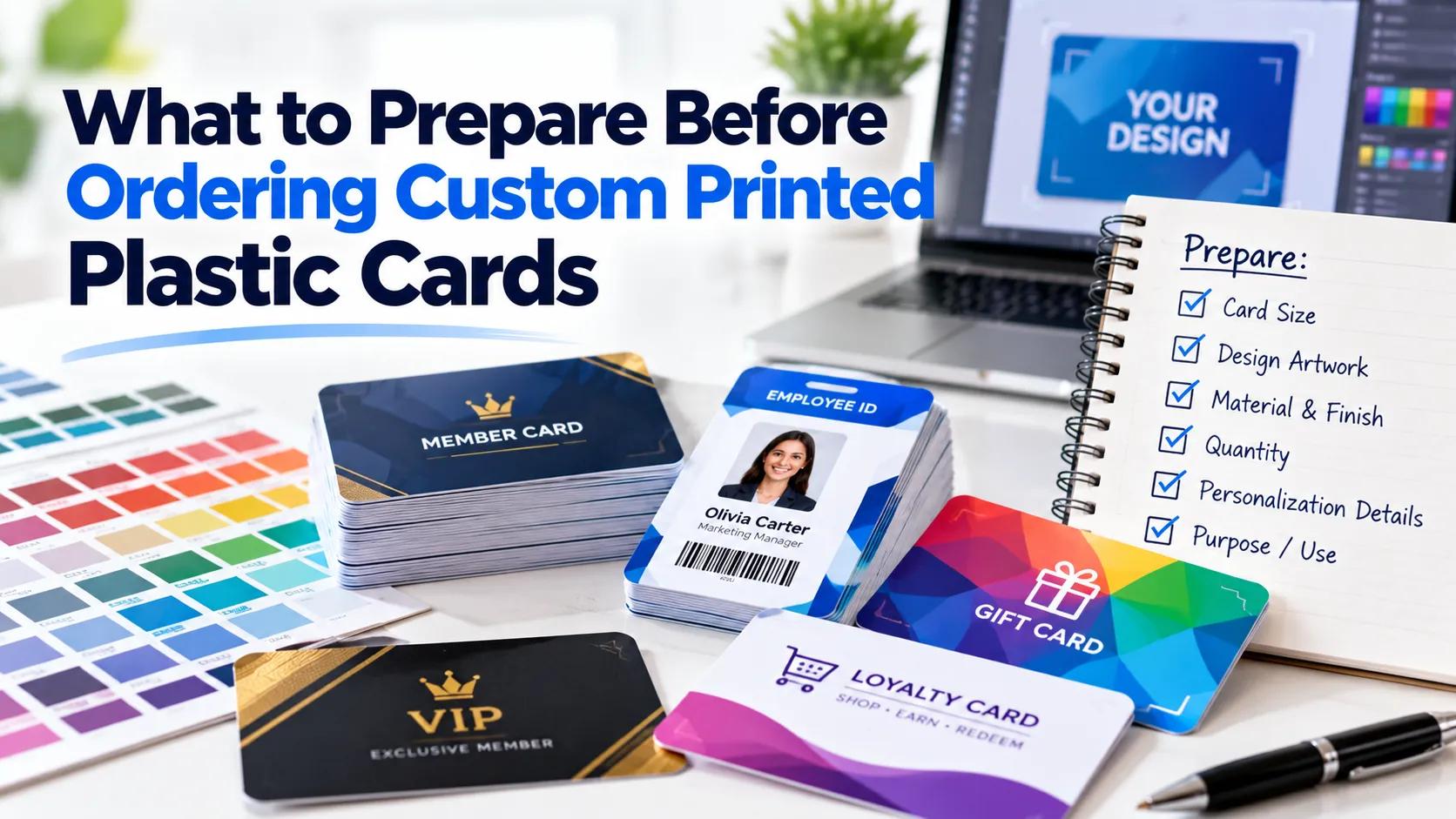
Most card orders hit delays for one simple reason: something was missing. A blurry logo, an unclear quantity, or a last-minute change to the barcode can push a project back by days.
A little preparation prevents that. Whether you need membership cards, gift cards, ID badges, or loyalty cards, custom printed plastic cards come together faster when you know what to gather first. This guide walks you through the steps so your order goes smoothly from the first message to final delivery.
Start With the Purpose
Before you think about colors or finishes, answer one question: what will this card do?
A card that opens a door has different needs than one that offers a discount. Knowing the job helps you pick the right size, material, and features.
Common uses include:
Membership and access cards
Gift and prepaid cards
Loyalty and reward cards
Employee and student ID badges
Key tags and combo cards
Plastic business cards
Quick tip: Write one sentence that describes the card’s job. Share it with your printer. It saves a lot of back and forth.
Gather Your Artwork
Your design is the heart of the order. Clean files lead to sharp results.
Have these ready:
Your logo: A vector file, such as AI, EPS, or a layered PDF, works best.
High-resolution images: Photos should be sharp at full print size.
Brand colors: Know your color codes so the printed card matches your other materials.
Fonts: Have the font files or be ready to convert text to outlines.
Text for both sides: Write out every line you want printed, and proofread it twice.
If you do not have artwork yet, that is fine. A good plastic card supplier can offer design help, so you do not need to start from scratch.
Decide on Size, Shape, and Thickness
Most plastic cards follow the standard credit card size of 3.375 by 2.125 inches, and many use 30 mil thick plastic. That size fits wallets, card readers, and most holders.
You also have options beyond the standard:
Custom shapes: Die-cut cards stand out and stay memorable.
Rounded corners: These feel smooth in the hand and resist snagging.
Key tag size: A smaller card or combo piece is ideal for key rings.
Different thicknesses: Heavier stock feels more premium, while thinner stock suits short-term use.
Quick example: A yoga studio may choose a leaf-shaped key tag for members, while a clinic may stay with a standard rectangle for staff badges.
Choose Your Finish and Extras
The finish changes how your card looks and feels. Extras add function and polish.
Think about these choices:
Gloss or matte: Gloss gives bright color, while matte gives a softer look.
Frosted or clear plastic: Great for a modern, eye-catching style.
Foil stamping: Adds a metallic accent to logos or names.
Spot UV: Creates raised, shiny highlights on selected areas.
Signature panel: Useful for cards that need verification.
Scratch-off panel: Popular for promo codes and gift cards.
Pick extras that serve the card’s purpose. Too many effects can crowd the design and raise your cost.
Plan Your Data Needs
If your cards need to work with a system, you must plan the data side before printing begins.
Prepare the following:
Barcodes or QR codes: Know the format and the numbers or links they will carry.
Magnetic stripe data: Confirm the type your readers use.
Sequential numbering: Decide on the starting number and any prefix.
Variable data: For names, photos, or personal details, prepare a clean spreadsheet.
A test plan: Scan or swipe a sample before approving the full run.
Quick tip: Keep your spreadsheet tidy. Fix spelling, remove duplicates, and use consistent formatting so nothing prints wrong.
Set Your Quantity and Timeline
Quantity affects price, and timing affects planning.
Count your needs: Estimate your current users, then add extra for growth and replacements.
Think about reorders: Ordering a bit more now often costs less than a second small run.
Know your deadline: Share your due date at the start so the team can plan production.
Allow time for proofs: Review and approval take a little time, so build that into your schedule.
Choosing the Right Plastic Card Supplier
Your results depend heavily on who prints your cards. A reliable plastic card supplier offers clear communication, quality materials, and guidance when you are unsure.
Ask any plastic card supplier these questions:
Do you provide design help or templates?
Will I see a proof before printing?
Can you add barcodes, stripes, or numbering?
What finishes and shapes are available?
How do you handle reorders?
Perfect Plastic Cards works with businesses of many sizes on custom printed plastic cards, from simple loyalty cards to cards with added data features. The team can guide you through material, finish, and design choices, then walk you through proof approval before production.
Common Mistakes to Avoid
A few small errors cause most of the headaches. Watch for these:
Low-resolution art. A blurry file will print blurry.
Text too close to the edge. Keep important details inside the safe area.
Skipping the proof. Read every word and test every code.
Unclear instructions. Short notes beat guesses.
Waiting until the last minute. Rushed orders leave less room to fix mistakes.
Final Thoughts
A smooth order starts with a clear purpose, clean artwork, and a few smart decisions about size, finish, and data. Spend an hour on preparation, and you can save days later. When you are ready to order custom printed plastic cards, a helpful plastic card supplier will turn your notes into a finished product you are proud to hand out.
Gather your files, write down your goals, and ask questions early. The result is a card that looks sharp and works the way you planned.
Frequently Asked Questions
1. What file format is best for my logo?
A vector file, such as AI, EPS, or a layered PDF, gives the sharpest results. High-resolution PNG or JPG files can also work.
2. How many cards should I order?
Count your current needs and add extra for growth and replacements. Larger runs often lower the cost per card.
3. Will I see a proof before printing?
Yes. A proof lets you review the design, text, and codes before the full run begins.
4. Can a plastic card supplier help with design?
Many can. Share your ideas and brand details, and the design team can shape them into a finished layout.
Ready to Get Started?
Now that you know what to prepare, the next step is easy. Visit the Perfect Plastic Cards website and book your free quote today. Share your goals, send your files, and the team will help you create cards that look great and work hard for your business.